
The UGG-ly Truth: An Australian Original Claimed by the World
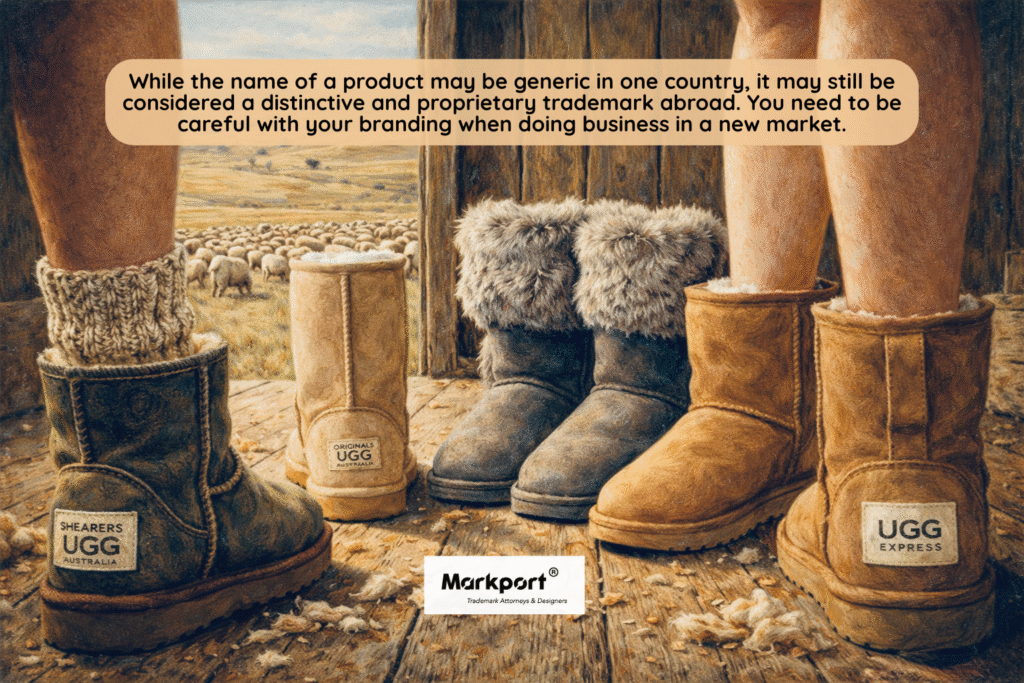
“UGG” is one of the most unusual trademark stories in fashion.
The term “ugg” originally referred to a type of sheepskin boot commonly worn in Australia. It dates back to at least the 1950s and was widely used by surfers for warmth. By 1981, “ug” appeared in the Macquarie Dictionary as a generic term for this type of footwear.
The name likely came from “ugly boots” or “ugg”, a slang expression describing their rough, practical look.
From there, the legal position diverged.
- In Australia and New Zealand, “ugg” is a generic term
- In more than 130 countries, “UGG” is a registered trademark owned by Deckers Outdoor Corporation, an American company
This has led to long-running disputes.
Australian businesses can sell “ugg boots” locally. However, if they sell overseas using that name, they risk infringement.
From Australian product to global brand
Ugg boots began as a functional Australian product, used by surfers and workers for warmth. Over time, they became a global fashion item, driven by international marketing and celebrity exposure.
An Australian entrepreneur introduced the product to the United States, built brand recognition, and later sold the business to Deckers. From there, the brand expanded rapidly and secured trademark protection in multiple countries .
Today, UGG is a global brand generating billions in revenue, while many original Australian makers remain limited to domestic use of the name.
This shift created a long-running conflict between local producers and an international rights holder.
A costly lesson: the Eddie Oygur case
Eddie Oygur, through his business Australian Leather, sold a small number of ugg boots online to customers in the United States.
The numbers were modest. About a dozen pairs over several years.
However, that was enough.
Deckers sued for trademark infringement. Oygur argued that “ugg” was a generic Australian term. The US courts rejected that argument and focused on how American consumers understand the term.
In 2019, he lost the case and was ordered to pay around US$450,000 in damages. Appeals failed, and the US Supreme Court declined to hear the case .
Legal costs reportedly escalated into the millions, placing the business at risk of collapse.
This case highlights a practical reality. Local understanding of a name does not protect you overseas.
Ongoing disputes with Australian manufacturers
The conflict has not been limited to one case.
Australian manufacturers have faced ongoing pressure when selling internationally. For example, UGG Since 1974, a long-standing Australian maker, was forced to rebrand to “Since 74” for overseas markets after legal action from Deckers .
Many local producers argue that “ugg” is part of Australian culture and should remain free for all to use. However, international trademark law focuses on registration and consumer perception in each market.
This has created a practical problem for SMEs. They can produce and sell authentic Australian boots, but cannot describe them using the term most consumers search for overseas.
Some businesses have struggled to compete globally as a result. Others have exited the market entirely.
How courts have treated “UGG” around the world
The UGG dispute has been tested across multiple jurisdictions, with different outcomes.
In Australia, IP Australia confirmed that “ugg” is a generic term in a case involving Uggs-N-Rugs. This allows multiple businesses to use the term locally, although specific logos can still be protected .
In the United States, courts have taken a different approach. In the Koolaburra case, the argument that “ugg” was generic was rejected. The court found that US consumers recognise “UGG” as a brand, allowing Deckers to enforce its rights .
European and other international courts have reached similar conclusions. In cases involving counterfeit or competing products, the use of “ugg” has been treated as infringement where it takes advantage of the UGG brand.
In Turkey, a local challenge to the trademark also failed. The court confirmed that “UGG” is distinctive in that market, regardless of its generic use in Australia.
These decisions follow a consistent principle. Trademark rights depend on how consumers in each country understand the name.
Why this matters for small businesses
Your brand name affects how far your business can grow.
The UGG case shows a clear risk. A name can be free to use in one country and restricted in another.
In Australia, “ugg” describes a product.
In the US and Europe, it identifies a single brand.
This leads to an important warning.
When entering a new market, always check trademark rights before using your brand. A name that is acceptable in Australia may infringe someone else’s rights overseas.
Many SMEs expand online without realising they are already operating internationally. The Oygur case shows how quickly this can lead to legal exposure.
When a brand becomes generic
Trademark protection depends on distinctiveness.
If a name becomes the common term for a product, it loses protection.
Examples include:
- Escalator, once a brand for moving staircases
- Popsicle, originally a branded frozen dessert
- Esky, now widely used in Australia for portable ice boxes
Across industries, other examples include Thermos, Aspirin, Cellophane, Trampoline, and Yo-Yo. These names started as trademarks but became generic through everyday use.
The UGG situation works differently. The name was already generic in Australia but became a protected brand elsewhere.
This highlights three points:
- Genericness depends on location
- Consumer understanding matters
- Each country applies its own legal test
How to avoid the same problem
The UGG dispute provides practical guidance for SMEs.
Choose a name you can protect
Avoid purely descriptive names that directly describe your product or service. A distinctive name is easier to register, enforce, and build into a valuable brand over time.
Plan for international use early
Online sales can expose your brand to global markets from the start, even if you intend to operate locally. Check availability in key countries early so you do not invest in a name you cannot use overseas.
Register before expansion
Trademark rights are territorial and do not automatically extend to other countries. If another party registers your name overseas first, you may face legal barriers or be forced to rebrand.
Use your brand consistently
Use your brand as a proper name, not as a generic product description. Consistent use reinforces distinctiveness and helps maintain your legal rights.
Align branding with legal strategy
Your brand design should support your legal protection, not work against it. A clear and consistent identity makes your brand easier to recognise, register, and defend.
Law and culture do not always align
In Australia, ugg boots are part of local culture and identity. Many producers have used the term for decades and see it as part of Australian heritage.
However, global trademark law focuses on ownership and market perception, not origin.
This creates tension between:
- Cultural use in Australia
- Legal ownership overseas
Some consumers respond by supporting Australian-made products, even when sold under different names internationally.
What this means for your brand
Brand decisions have long-term consequences.
A name can support growth, limit expansion, or force a rebrand later. The outcome depends on the decisions you make at the start.
Choose a name that you can own, not just one that describes what you sell. Check availability before investing in branding, secure protection in the markets that matter, and maintain control as your business grows.
This is where the right guidance makes a real difference. We work with businesses to assess whether a name is protectable, identify risks across jurisdictions, and secure trademark rights in Australia and overseas. We also ensure that branding and design support legal protection, so your brand is consistent, distinctive, and easier to defend.
If you want to avoid costly mistakes and build a brand you can grow with confidence, start with a clear and practical strategy.
https://markport.com.au/contact-us/
Further Reading
Sherlock, A. (2025, January 16). Legally, they can’t be called ‘uggs’ outside of Australia – but the name will stick regardless. The Conversation. https://theconversation.com/legally-they-cant-be-called-uggs-outside-of-australia-but-the-name-will-stick-regardless-247562
Yun, J. (2025, January 17). ‘Morally, it sucks’: Inside the uggly fight over Australia’s iconic sheepskin boots. The Sydney Morning Herald. https://www.smh.com.au/business/companies/morally-it-sucks-inside-the-uggly-fight-over-australia-s-iconic-sheepskin-boots-20250115-p5l4jw.html
Dodgson, L. (2025, January). Australian ugg-boot maker forced to rebrand after trademark battle with American rival. Business Insider. https://www.businessinsider.com/ugg-boot-maker-since-1974-rebrands-trademark-battle-deckers-2025-1
Markport Trademark Attorneys & Designers. (2025). Trademarks FAQ for Australia. https://markport.com.au/trademarks-faq-for-australia/